

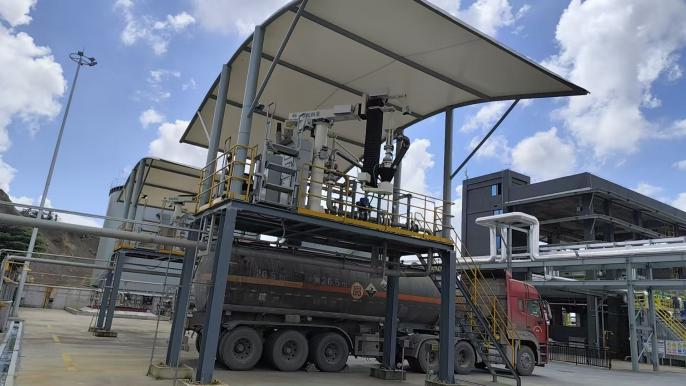
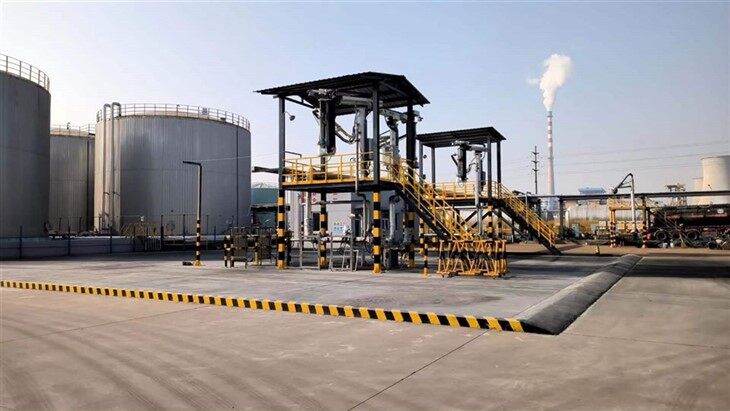
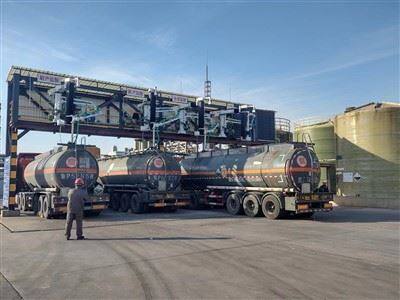
Fully Automatic Truck Loading Arm
This system is an intelligent filling solution for smart management, the first of its kind in China and the industry's pioneering model. It effectively addresses long-standing challenges in the domestic sector and fills the gap in the automation and intelligence of non-volatile liquid filling.
The system integrates machine vision, advanced control systems, and supporting information software, and is primarily applied in top-open loading arm operations. It significantly enhances the level of intelligence in enterprise loading arm filling processes.
Automatic Loading Arm Operating Instructions
The driver drives the vehicle into the loading area and waits for the system prompt to stop.
The driver inserts the key into the controller, connects the grounding clamp, and places the wheel chocks.
Proceed to the IC card scanning area and scan for loading authorization.
Press the start button - the loading arm automatically aligns and begins loading.
After loading is completed, the loading arm automatically retracts.
The driver restores the grounding clamp and wheel chocks, retrieves the key, and starts the vehicle.
Loading is completed.
Automatic Positioning Process
- The tank truck enters the loading area.
- The camera captures images and reads the manhole coordinates.
- The backend software calculates the movement distance.
- The servo system drives the loading arm to move.
- The loading arm reaches the preset coordinates and inserts into the manhole.
- Positioning is completed, and loading begins.

Pain Points of Traditional Operation Mode
- At present, most plants rely on operators visually checking the liquid level inside the tank truck to determine whether it is full. This method has large errors.
- Operators manually insert the loading arm into the tank truck manhole. The work is labor-intensive, performed at a high platform (generally over 5 meters above ground), and involves hazardous chemicals that are highly corrosive and toxic. This poses significant safety risks, and any mishandling may result in serious injuries or fatalities.
- Lack of static electricity discharge increases the risk of fire.
- Manual loading is difficult, with high operational complexity and risk of overfilling that causes environmental pollution.
- Inaccurate filling volumes make supervision and regulation difficult.
- Dangerous working conditions (high platforms and hazardous chemicals) with no reliable safety protection.
- Visual measurement for quantity leads to low efficiency, high error rate, and heavy workload.
- Single-arm operation results in low efficiency and high cost.
System Advantages
- Achieves full-process automation of weighing and loading through remote control, reducing labor intensity while improving efficiency and accuracy.
- Introduces the industry's first domestic application of machine vision + control system technology, replacing manual control for inserting the loading arm into the tank, and significantly improving positioning efficiency.
- Utilizes AI video analysis to monitor vehicle and personnel status at the loading site, providing real-time safety protection during the loading process.
- Supports integration with weighbridge systems and quality inspection terminal printing systems, enabling seamless data exchange and eliminating data silos.

Equipment Specifications
|
Item |
Specification |
|
Equipment Name |
Intelligent Loading Arm |
|
Model |
TL1303V9 |
|
Loading Arm Diameter |
DN50–DN150 |
|
Material |
Carbon Steel, 304, 316L |
|
Positioning Time |
30 seconds |
|
Motion Type |
XYZ three-axis independent control, independent movement |
|
Distance from Platform Edge (Width Direction) |
2000 mm |
|
Platform Height |
2850 mm |
|
Loading Arm Movement Range (Parallel to Platform) |
1200 mm |
|
Loading Arm Movement Range (Vertical to Platform) |
1000 mm |
|
Operating Mode |
Automatic |
|
Power Supply |
Servo Motor |
|
Alignment with Tank Opening |
Automatic |
|
Loading Arm Installation Height |
Above reference surface |
|
Control Method |
Motion Controller, Programmable Logic Controller (PLC) |
|
Communication Method |
TCP/IP, RS485, with signal upload capability |
System Applications
|
Automatic Positioning System |
By integrating machine vision, upper-lower computer communication, and control system technologies, the system establishes a loading arm motion model and recognition-positioning algorithm. It replaces manual operation to achieve one-click intelligent loading. |
|
Automatic Tank Truck Hatch System |
Based on signal interaction between the hatch mechanism and the automatic positioning platform, the system enables automatic opening and closing of tank truck hatches, replacing manual operation on top of the tank. |
|
Automatic Residual Liquid Recovery System |
After loading is completed, the system automatically recovers the residual medium in the loading arm, preventing environmental pollution and replacing the traditional manual drum method. |
|
Quantitative Loading System |
Based on the control system and on-site instruments, the system precisely monitors the loading volume during the filling process and provides reliable, multiple safety interlocks, achieving automated quantitative loading. |
|
Unattended Truck Scale Weighing System |
Utilizing license plate recognition to obtain order information, infrared sensors to prevent vehicle scale fraud, real-time video monitoring, and voice broadcast alerts, the system enables fully unattended, fast, and accurate remote weighing operations. |
System Adaptability
The system is primarily designed for scenarios using top-open loading arms in industries such as local refineries, sulfuric acid, and chlor-alkali. Each subsystem can be sold modularly or as a complete full-process solution, and customized development is also supported to meet the client's specific on-site requirements.


